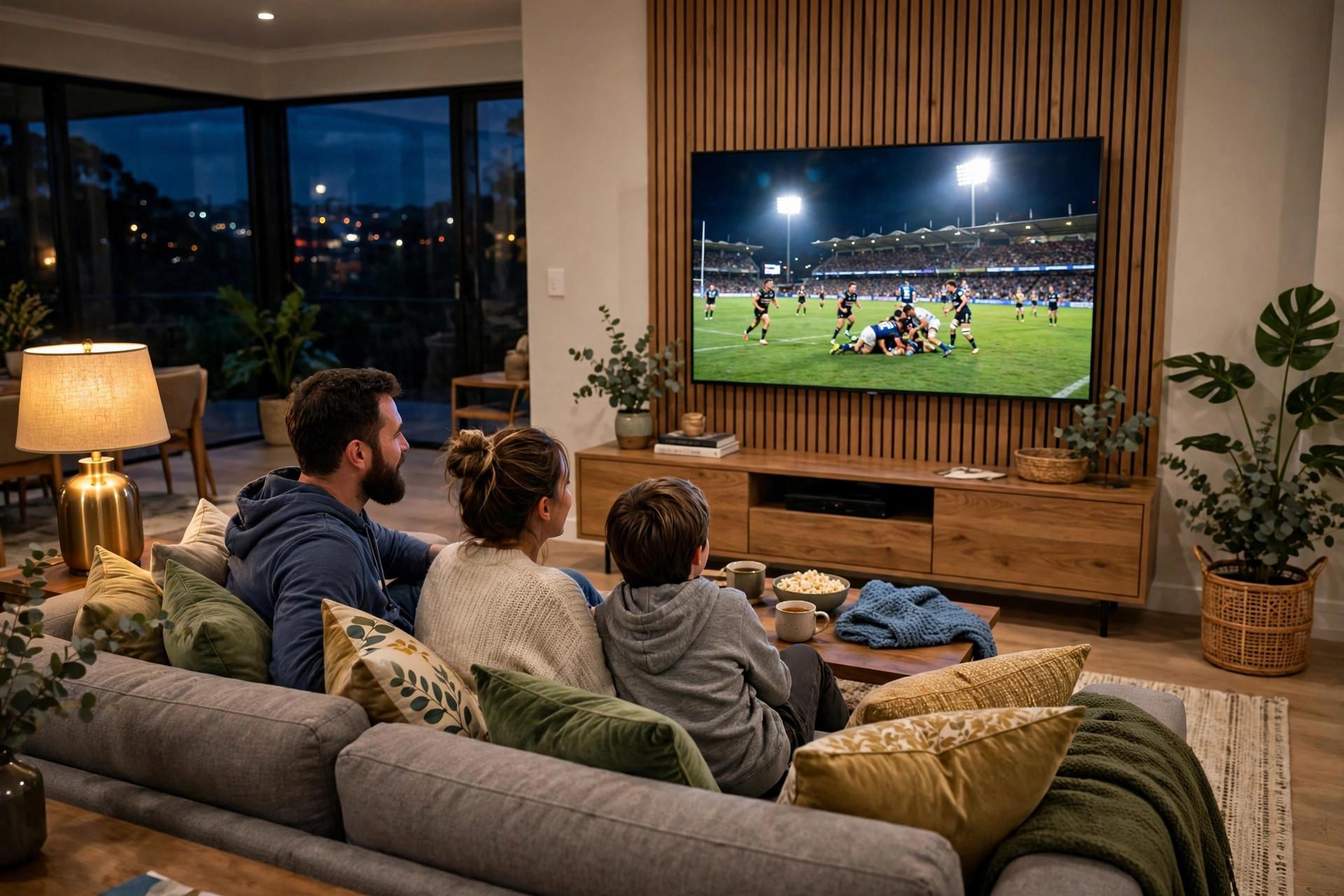
Picking the best IPTV Australia has to offer in 2026 comes down to one question: does it show the sport you actually watch, on the nights you actually watch it? A service can list 50,000 channels and still be useless if the AFL drops out at three-quarter time, or if the State of Origin decider freezes on the opening kick-off. The services that win in Australia are the ones that hold up on a Friday night in Melbourne when Collingwood and Carlton are playing, on a Wednesday night in Brisbane when Origin is on, and on Boxing Day when the MCG is full. That is the bar this guide uses, and it is the bar 4K Media Australia is built to clear.
Start with what you get. Premium carries 57,000+ live channels, 185,000+ movies and 49,000+ series, with the Australian free-to-air channels — Channel 7, Channel 9, Channel 10, ABC and SBS — sitting next to Fox Footy, Fox Cricket, Fox League, ESPN, beIN Sports, Optus Sport and Stan Sport. The point of a big list is not the number. It is that the channel you want at 7:30pm on a Saturday is there, in 4K, with a working TV guide. Basic is the cheaper way in: 10,000+ channels and 80,000 movies and series in HD and Full HD from $14.99 a month, with AFL, NRL and cricket included.
Best IPTV Australia: How the Free Trial Settles It
No review replaces a live test on your own TV and your own NBN connection. That is why the 24-hour free trial matters more than any feature list. Message 4K Media Australia on WhatsApp, get your login within minutes, and watch the trial the way you would watch a normal week: an AFL game on Fox Footy, a movie in 4K after dinner, the news on Channel 9, and a Premier League match late on Saturday night. If the picture holds through the peak hours — 7pm to 10pm, when every street in your suburb is streaming — the service will hold through anything. The trial costs nothing and asks for no card, so there is no reason to buy blind.
While you test, keep a simple scorecard. Write down the three channels you watched most, whether any of them buffered, how fast the channel changed when you flipped, and whether the EPG matched what was actually on. Then message support on WhatsApp with a question and time the reply. A good provider answers in minutes, not hours. That five-minute check tells you more about the next twelve months than a hundred reviews, because support is the thing you need at 9pm on Grand Final day, not on a quiet Tuesday.
What Best IPTV Australia Must Cover: AFL, NRL and Cricket
Australia is a sport-first TV market, and the calendar proves it. The AFL season runs from March to the Grand Final on the last Saturday in September at the MCG, with Gather Round in Adelaide in April and Thursday and Friday night games every week. The NRL runs alongside it, with State of Origin's three games in June and July the biggest television nights of the winter. Summer belongs to cricket: the Ashes, the Boxing Day Test at the MCG, the New Year's Test at the SCG, the day-night Test in Adelaide, and the Big Bash League through December and January. A service that calls itself the best IPTV Australia option has to carry all three codes live, and 4K Media Australia does — read the deep dives on watching the AFL live, State of Origin and the Ashes for the full breakdowns.
- AFL: every round live, plus the Grand Final, Gather Round and the Brownlow Medal count.
- NRL: every round, State of Origin, the finals series and the Grand Final at Accor Stadium.
- Cricket: the Ashes, Boxing Day and New Year's Tests, ODIs, T20s and the Big Bash League.
- Football: every Premier League match, the FA Cup, Champions League and the A-League.
- Racing and PPV: Melbourne Cup week, the Australian Grand Prix, UFC and boxing pay-per-views.
Best IPTV Australia Prices: What $19.99 Actually Buys
Premium starts at $19.99 for one month. Three months is $49.99, six months is $79.99, and twelve months is $99.99 — about $8.33 a month, which is less than a single month of Kayo One. The yearly multi-device plans are where households save the most: $159.99 for two devices, $224.99 for three and $269.99 for four, all for twelve months. Basic runs $14.99 a month, $24.99 for three months, $39.99 for six and $59.99 for twelve. Every plan is paid by card through Stripe, and every plan starts with the same free 24-hour trial, so you can check the price against the picture quality before you commit.
| Plan | 1 month | 3 months | 6 months | 12 months |
|---|---|---|---|---|
| Basic | $14.99 | $24.99 | $39.99 | $59.99 |
| Premium | $19.99 | $49.99 | $79.99 | $99.99 |
| Premium 2 devices (12 mo) | — | — | — | $159.99 |
| Premium 4 devices (12 mo) | — | — | — | $269.99 |
Compare that with the apps you would need to replace. Kayo One starts at $25 a month and Kayo Premium is $40 a month, and neither carries the free-to-air channels, the movies or the international leagues. Foxtel Plus at $49 a month plus the Sport pack at $29 comes to $78 a month before movies. Optus Sport alone is $24.99 a month. Add them up and a household that follows AFL, NRL, cricket and the Premier League can easily spend $100 a month across three or four apps. One Premium subscription at $8.33 a month on the yearly plan covers the same nights. The full price comparison is in the Kayo vs IPTV guide and the Foxtel vs IPTV guide.
Setup in Five Minutes, On the Devices You Already Own
The second test of the best IPTV Australia service is how fast it lands on your TV. On a Firestick it takes about five minutes: install Downloader, install IBO Pro Player via Downloader (ask on WhatsApp for the current code), send the MAC address and key to WhatsApp, and the playlist is activated. On a Samsung or LG smart TV it is the same idea through IBO Player from the app store. On Android TV and Nvidia Shield, TiviMate is the player most people settle on, and on a phone or iPad it is IPTV Smarters Pro. The step-by-step for each one is in the Firestick setup guide, the TiviMate setup guide and the Samsung and LG smart TV guide. If any step stalls, support does a free remote install over WhatsApp.
Buffering, NBN Speed and the Honest Limits
A fair guide names the limits. IPTV needs a steady connection, not a fast one on paper: 25 Mbps is enough for a stable 4K stream, 10 Mbps covers Full HD, and most buffering in Australia is a Wi-Fi problem, not a server problem. If your NBN 50 plan tests at 45 Mbps at the modem and 8 Mbps in the back bedroom, the TV in the back bedroom will buffer on any service. The fixes are unglamorous — Ethernet where you can, 5 GHz Wi-Fi where you cannot, and a restart of the router and the app before a big game. The full checklist is in the buffering fix guide and the NBN speed guide. And if the trial shows your connection cannot hold 4K at peak hour, the honest answer is to watch in Full HD, not to buy a dearer plan.
So here is the short version. The best IPTV Australia option in 2026 is the one that shows your codes live, holds up at peak hour, sets up in five minutes on the TV you already own, and costs less per month than a single sports app. Premium at $19.99 a month, or $99.99 for the year, does that with 57,000+ channels behind it. Start with the free 24-hour trial tonight — pick the biggest game on, watch it properly, and let the picture decide.
How to judge picture quality before you pay
Every IPTV seller writes 4K on the sales page, and the word has lost most of its meaning. Real 4K means the stream arrives at 2160p and stays there through a fast passage of play, not that the menu looks sharp while the match turns to mush. The honest test is a live game, not a movie trailer. Put on a Friday night AFL match or a State of Origin decider during your free trial and watch the grass, the players' jumpers and the score bug in the corner. If the grass smears when the camera pans across the MCG and the score bug goes soft every time the play moves quickly, you are watching an upscaled HD feed with a 4K label on it. A genuine 4K feed holds the detail through the pan, the tackle and the replay, and it does it at 8pm on a Friday when half the street is streaming at the same time.
The box under the TV matters as much as the subscription. A Firestick 4K Max or a recent Apple TV 4K will hold a 4K stream without breaking a sweat, while a five-year-old stick on congested Wi-Fi will drop frames no matter how good the playlist is. Plug the stick into the TV's best HDMI port, switch the TV's motion smoothing off — it makes sport look like a soap opera — and set the picture mode to Sport or Cinema rather than Vivid, which blows the colours out. Then run the same test twice: once over Wi-Fi and once over an Ethernet cable or a powerline adapter. If the cable fixes the picture, the subscription was never the problem, and the buffering fix guide walks through the rest of the checks in order.
The channel list Australian households actually use
A big channel count looks impressive on a sales page, but most households watch the same twenty channels every week. The list that matters in Australia starts with the free-to-air five — Channel 7, Channel 9, Channel 10, ABC and SBS — plus the multichannels like 7mate, 9Gem and 10 Bold where the sport and the movies hide. Then come the Fox channels: Fox Footy for every AFL game, Fox League for every NRL game, Fox Cricket for the Tests and the Big Bash, and Fox Sports 503 to 507 for the rest. ESPN carries the NBA and the American sport, beIN Sports carries La Liga and Serie A, Stan Sport carries the Champions League and the rugby, and Optus Sport carries the Premier League. A service that has all of those in one EPG has covered the Australian sporting year. A service missing one of them will send you back to a second subscription by March.
The second half of the list is the one people forget until they need it. Migrant households in Sydney, Melbourne and Brisbane want the channels from home — Indian channels for the cricket and the Bollywood movies, Filipino channels for the teleseryes, British channels for the soaps and the news, Greek and Italian channels for the parents. Premium carries 57,000+ channels, so those feeds sit next to the Australian ones instead of needing a separate dish or a second app. The video-on-demand library does the same job for nights without live sport: 185,000+ movies and 49,000+ series, from new releases to the box sets people rewatch every winter. Check the price plans before you decide, because the difference between Basic and Premium is exactly this depth — Basic covers the Australian sport in HD, Premium adds the world in 4K.
One subscription, every room in the house
The lounge TV is only the start. In most Australian homes the second screen is the bedroom TV, the third is a tablet in the kids' room, and the fourth is a phone on the train. Multi-device yearly plans exist for that shape of household: Premium for two devices is $159.99 a year, three devices is $224.99 and four devices is $269.99, which works out to about $5.62 a month per device on the four-device plan. Each device logs in with the same playlist, and each one keeps its own favourites list in the player app, so the kids' favourites in TiviMate do not clutter the lounge EPG and the lounge favourites do not show up on the phone.
Before you pay for any IPTV service in Australia, run the checks below during the free trial. They take one evening and they catch every common disappointment — the service that buffers at 8pm, the guide that never loads, the support team that never answers. A provider that passes all five is worth the yearly plan. A provider that fails two of them is not worth the monthly plan either, because the problems do not fix themselves after you pay.
- Watch your own team live on game night, not a replay at noon. Peak-hour live sport is the only honest load test.
- Open the TV guide and check it lists tonight's games with the right times. A blank or wrong EPG ruins the service faster than any buffering.
- Play a 4K movie at 8pm and watch the first ten minutes. If it holds, the connection and the playlist are both fine.
- Message support on WhatsApp with a real question and time the reply. You will need them at 7:25pm on a Friday one day.
- Read the refund terms before paying. 4K Media Australia offers a 7-day money-back guarantee, 30 days on yearly plans — know the window before you need it.